

Most people think you need years of experience to work in care.
You don't.
Support work is one of the few jobs in the UK where employers expect to train you. What they want first is the right attitude. The skills come with the job.
Here is what you need, what it pays, and how to land your first role.
Why employers hire people with no experience
Care is short of people. Skills for Care's 2026 report on the adult social care workforce in England counted 96,000 vacant posts in 2025/26.
"Care worker and support worker" is also the biggest job in the sector, with 925,000 filled posts. That is 58% of everyone working in adult social care.
So employers can't wait for experienced staff to apply. They recruit kind, reliable people and teach them the rest.
What a support worker actually does
You help people live as independently as they can. That might be in their own home, in supported living, in a care home or in the community.
A normal shift can include:
- Helping with personal care, such as washing and dressing
- Preparing meals and supporting people to eat and drink
- Prompting medication, once you are trained to
- Helping people get to appointments, college, work or social activities
- Writing short, clear notes about each visit or shift
- Spotting changes in someone's health or mood and reporting them
Some roles focus on older people. Others support adults with a learning disability, autism or mental health needs. Read every role in the UK care sector, explained to see where support work fits.
What you actually need
You need:
- The right to work in the UK
- An enhanced DBS check. Your employer usually arranges this. For care roles it normally includes a check of the adult barred list (GOV.UK explains the levels)
- References, usually from your last employer or a school, college or volunteering role
- Reasonable spoken and written English, so you can talk to people and keep records
It helps to have:
- A full UK driving licence, especially for home care
- Flexibility to work some evenings and weekends
You don't need:
- A care qualification
- Paid care experience
Step 1: Turn what you've already done into care experience
You have more relevant experience than you think.
- Looked after a family member? That is personal care, patience and trust.
- Worked in a shop, café or call centre? That is communication, reliability and staying calm under pressure.
- Volunteered? That shows you care about people without being paid to.
Put these on your CV with one line about what you did and what it taught you. Avoid the mistakes in 5 common CV mistakes for home care jobs.
Step 2: Learn the basics before you apply
Every new care worker is expected to meet the Care Certificate standards. These were updated in March 2025 and there are now 16 standards. They cover things like duty of care, safeguarding, infection control, communication and health and safety.
Your employer will take you through them during your induction. But learning some of it first shows you are serious, and it gives you real things to talk about at interview.
The SupportiveBridge Training Academy has short online courses based on the Care Certificate standards. Each one ends with an assessment and a certificate you can add to your CV.
Step 3: Search for jobs that train you
Look for these words in the advert:
- "No experience needed" or "Training provided"
- "Full induction" or "Shadow shifts"
- "Entry level"
On SupportiveBridge, search for "support worker" and tick Entry under Experience. Jobs marked Easy Apply let you apply in a couple of minutes.
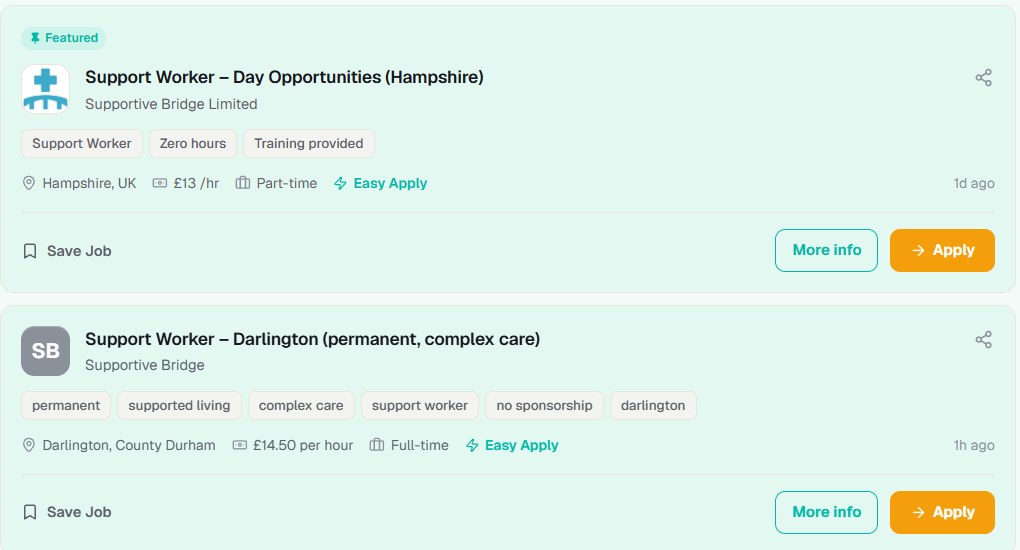
Apply to several at once. A good target is five to ten applications a week, each with a short note about why you want to work in care.
Step 4: Get ready for a values-based interview
Care interviews are less about what you know and more about how you would treat people.
Expect questions like:
- "Why do you want to work in care?"
- "Tell us about a time you helped someone who was struggling."
- "What would you do if a person refused their care?"
- "What would you do if you were worried someone was being harmed?"
Answer with real examples from your life, even if they are not from a care job. Our guide to home carer interview questions and answers has sample answers.
Step 5: Make the most of your first weeks
Your first weeks are mostly learning:
- An induction with the company's policies and training
- Shadow shifts, where you work alongside an experienced colleague before working on your own
- Working through the Care Certificate standards, with a senior or assessor checking you can do each part in practice
Ask questions. Write things down. Nobody expects you to know everything on day one.
What does a support worker earn?
From 1 April 2026 the National Living Wage is £12.71 an hour for anyone aged 21 and over. It rises to £13.21 in April 2027 (GOV.UK).
Skills for Care found the median hourly pay for care workers and support workers was £12.60 in March 2026, just before the April increase. So most entry-level roles now start at or a little above the National Living Wage. Many employers pay more for nights, weekends, driving or complex care.
Where it can lead
Support work is the first step on a real career ladder. With time and training you can move into:
- Senior support worker or team leader
- Care coordinator or deputy manager
- Registered manager
- Specialist roles in mental health, learning disability or complex care
- Nursing, through an apprenticeship or degree
The Level 2 Adult Social Care Certificate builds on the same 16 standards and is the next qualification many people take. See the qualifications you need for a career in home care for the full path.
Start today
You don't need experience to become a support worker. You need to care, to turn up, and to be willing to learn.
Browse support worker jobs on SupportiveBridge →
Sources: Skills for Care, The state of the adult social care sector and workforce in England (October 2026); Skills for Care, Care Certificate standards (2025); GOV.UK, National Minimum Wage and National Living Wage rates.