

Many support workers in the UK started with no care experience at all. Employers in supported living, learning disability services, mental health and home care often hire people for their attitude and train them on the job. This guide explains, step by step, how to get your first support worker role.
What does a support worker do?
A support worker helps people live as independently as possible. Depending on the service, that can mean helping someone with shopping, cooking, medication prompts, appointments, personal care, budgeting or getting out into the community. You might work in a supported living house, someone's own home, a care home or a day service, on days, nights, waking nights or weekends.
Step 1: Check you have what employers look for
You do not usually need a qualification to start. Employers look for:
- The right values: kindness, patience, respect and reliability.
- Good communication: listening well and writing clear notes.
- Life experience that counts: caring for a family member, volunteering, customer service or hospitality all show useful skills. Put them on your CV.
- Right to work in the UK: you will be asked to prove it before you start.
- Sometimes a driving licence: some community and home care roles say "driver essential", so check each advert.
Step 2: Get your CV ready
Keep it to two pages. Lead with a short profile that says why you want to support people, then list any caring, volunteering or people-facing work. Read our guide to 5 common CV mistakes for care jobs before you apply.
Step 3: Understand the checks
Before you start, the employer or agency will carry out pre-employment checks. For most support worker roles these include:
- An Enhanced DBS check (with a barred list check for roles working closely with adults or children). The employer arranges this. You can read how DBS checks work on GOV.UK.
- Right to work: for example your passport, or a share code if you have an eVisa or settled status.
- References: usually from recent employers, or a character reference if you have not worked before.
- ID and address checks, and an interview.
Having your documents ready speeds everything up.
Step 4: Complete your induction and the Care Certificate
New starters in health and social care usually complete the Care Certificate as part of their induction. It is a set of standards, not a qualification, normally completed within about 12 weeks of starting. Since March 2025 it has 16 standards, including a new standard on awareness of learning disability and autism (NHS Employers).
Your employer will normally arrange this training. If you want to learn before you apply, short online courses on topics such as Duty of Care, Infection Prevention and Control, and Moving and Handling of People are available from training providers, including the Supportive Bridge Training Academy. Courses are optional: you do not need to buy a course to apply for jobs or to work with us.
Step 5: Prepare for the interview
Expect questions about why you want to do the job, how you would respect someone's choices, and what you would do in a difficult situation. Use real examples from your life. Our home carer interview questions and answers guide works well for support worker interviews too.
Step 6: Apply for support worker jobs
Search support worker jobs on Supportive Bridge. Many listings come straight from employers' own careers websites, and the apply button takes you to the employer. Look for adverts that say "no experience needed", "full training provided" or "Care Certificate provided".
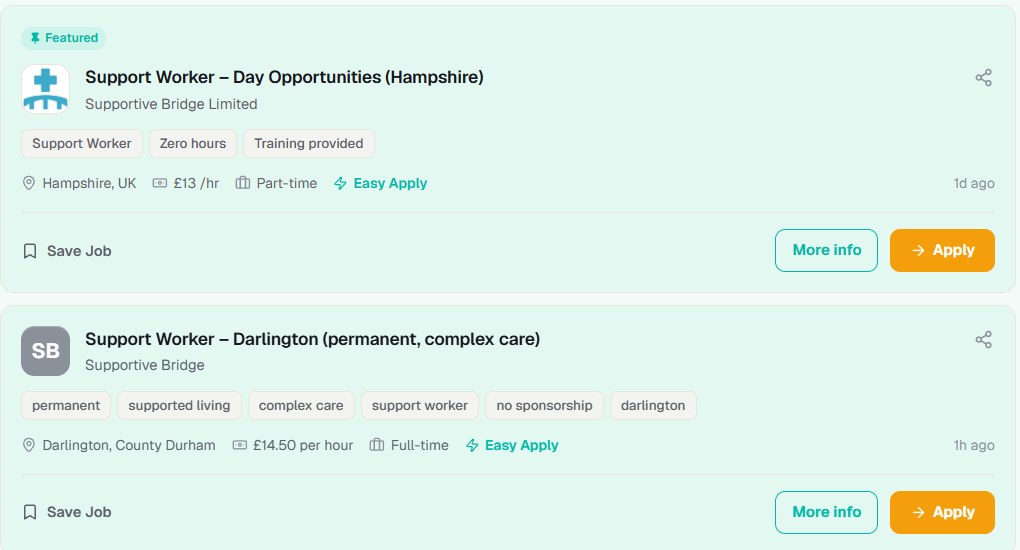
You can also create a free profile so that our recruitment team can contact you about suitable work. Applying is free. Never pay anyone for a job offer.
Where can a support worker career lead?
With experience and training, many support workers move up to senior support worker, team leader, deputy manager or registered manager, or into specialist areas such as mental health, autism support or complex care. See every role in the UK care sector explained for the full picture.
Quick checklist
- CV ready, with caring or people-facing experience
- Proof of right to work
- Two referees (or a character reference)
- Ready for an Enhanced DBS check
- Applied to at least three support worker jobs near you
Ready to start? Find support worker jobs near you.